
Star Wars Jedi: Survivor's PS5 Pro Performance Issues: A Technical Examination
The PS5 Pro's major graphical upgrade for Star Wars Jedi: Survivor, promising enhanced visual fidelity, is critically undermined by technical issues like flickering textures and graphical instability, as revealed by Digital Foundry's analysis.
The PlayStation 5 Pro was marketed as a significant leap forward for enhancing existing PS5 games, promising superior visual fidelity and performance. However, a notable exception has emerged with Star Wars Jedi: Survivor, a title that was confirmed early as receiving a PS5 Pro upgrade but appears to perform worse on the new hardware according to technical analysis. This revelation is particularly striking given the game's prominence and the console's selling proposition. Upon the PS5 Pro's release in late 2024, a vast library of games received updates, including Respawn Entertainment's acclaimed action-adventure title. Publisher Electronic Arts had detailed a list of anticipated technical improvements, such as higher base resolutions across both Performance and Quality modes, aiming to deliver a more polished experience for Cal Kestis's journey.
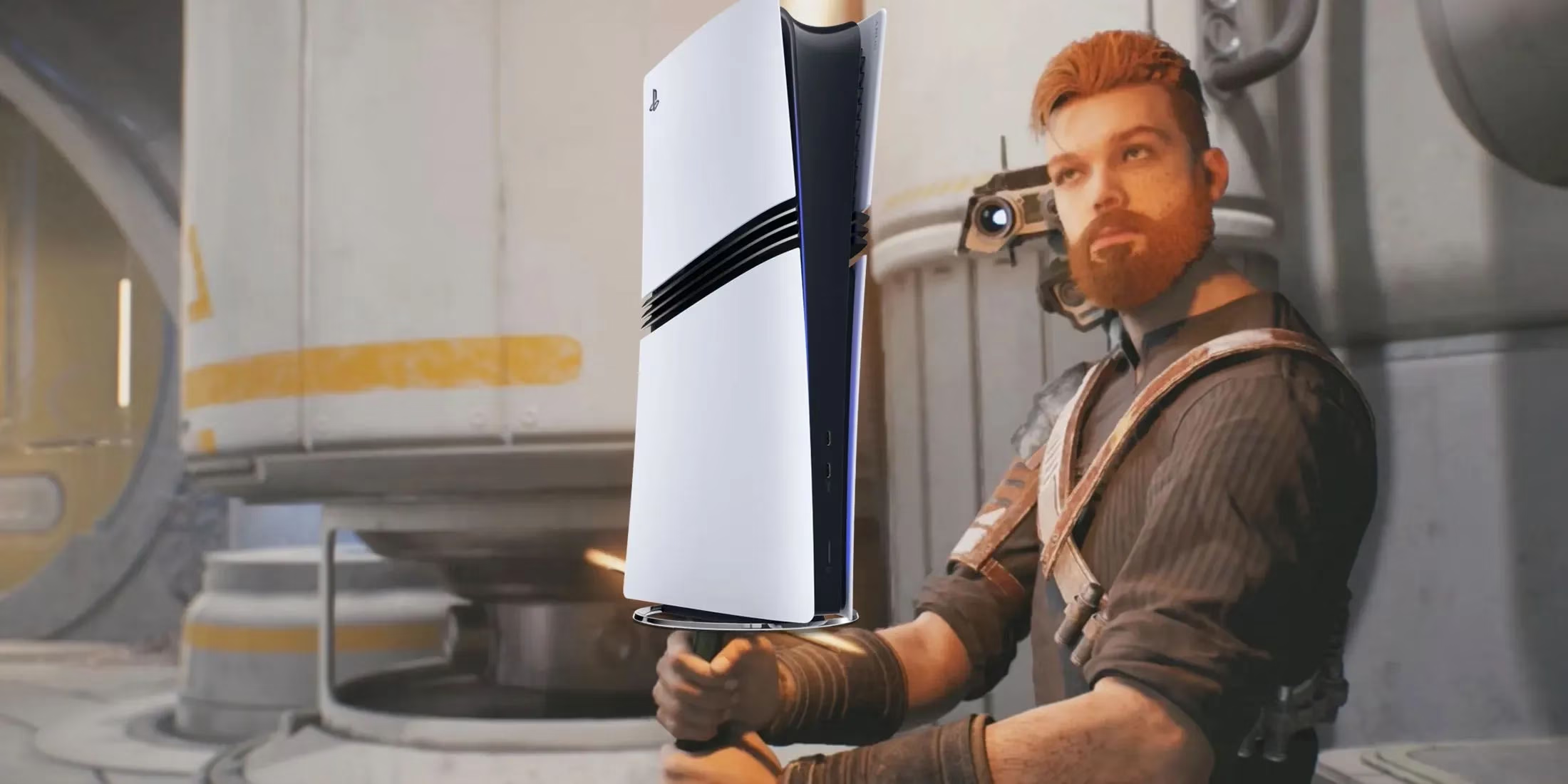
The Promise vs. The Reality of Graphical Upgrades
Electronic Arts outlined specific enhancements for Star Wars Jedi: Survivor on the PS5 Pro. In Quality Mode, the resolution was upscaled from 1800p to a native 4K 2160p, all while maintaining ray-traced lighting elements. Performance Mode, targeting 60 frames per second, saw its resolution increased from 1200p to 1800p. On paper, these upgrades suggested a clear win for players seeking either visual grandeur or smooth gameplay. The technical specifications promised a noticeable leap, leveraging the PS5 Pro's increased power for a more immersive galactic adventure. Many players eagerly anticipated these improvements, expecting the lush planets and detailed character models to shine brighter than ever before.
Digital Foundry's Critical Analysis
Despite the promising specifications, the engineering team at Digital Foundry conducted a deep technical analysis, revealing significant shortcomings. Their findings, detailed in a comprehensive YouTube video, painted a concerning picture. The team tested all graphical modes and settings, concluding that the PS5 Pro's enhancements were underwhelming and, in key areas, detrimental. The core issues appear to be tied to the console's new PlayStation Spectral Super Resolution (PSSR) technology. This AI-driven upscaling solution, while innovative, seems to be the source of the visual instability observed in the game.
Key Issues Identified in Performance Mode:
-
Flickering and Strobing Textures: Elements like foliage and environmental details exhibit constant flickering, making the image look unstable and distracting.
-
Graphical Instability: The overall image integrity is compromised, failing to deliver the "clean" upgrade expected.
-
Persistent Aliasing: Minor but noticeable jagged edges remain on objects, detracting from the sharper image goal.
Oliver Mackenzie of Digital Foundry noted that while the image could appear sharper in motion, these gains were heavily offset by the introduced artifacts. The problems were less severe in controlled, artificial environments like the opening Coruscant sequence, but they became rampant in the game's natural, foliage-heavy landscapes.
Problems Extend to Quality Mode
The issues were not confined to the performance-oriented setting. Quality Mode, designed for the highest visual fidelity, suffered from its own set of problems:
-
Lighting Pop-in: Environmental lighting would suddenly appear or change as the player moved, breaking immersion.
-
Missing Lighting Details: Certain lighting effects present in the standard PS5 version were absent or incorrectly rendered.
-
Retained Image Issues: While less severe, the flickering and instability from Performance Mode were still observable.
This indicates a systemic problem with the game's PS5 Pro implementation, affecting both major graphical presets. The promise of a stable 4K experience with ray tracing was undermined by these technical hiccups.
A Wider Pattern of PS5 Pro Challenges
Star Wars Jedi: Survivor is not an isolated case. It joins a growing list of titles reporting technical regressions on the new hardware. Other major games, such as Alan Wake 2 and the Silent Hill 2 Remake, have encountered similar issues, suggesting potential teething problems with the PS5 Pro's architecture or its PSSR technology when applied to certain game engines. This pattern has fueled skepticism among the gaming community, especially considering the PS5 Pro's premium price point at launch. The console faced controversy for its cost, and these performance issues with high-profile games have not helped its perception.
The Path Forward: Patches and Player Expectations
As of 2026, the situation highlights the complex challenge of backward compatibility and enhancement on new hardware. The responsibility now likely falls on the developers at Respawn Entertainment and publisher EA to address these shortcomings through post-launch patches. The gaming community is accustomed to games receiving performance fixes after release, and there is a reasonable expectation that these PS5 Pro-specific issues will be prioritized. However, the initial launch state serves as a cautionary tale. It underscores that raw hardware power and new upscaling technologies do not automatically guarantee a better experience; meticulous software optimization remains paramount. For now, players seeking the optimal experience for Star Wars Jedi: Survivor may find the standard PS5 version offers a more stable and consistent presentation, which is a surprising conclusion for a console generation's "Pro" model. The incident serves as a reminder that in the pursuit of graphical excellence, stability and polish are just as critical as resolution numbers and feature lists.
Leave a Comment
Comments