
Shadow of the Erdtree's Missed Opportunity with Godwyn the Golden
Exploring the Elden Ring DLC's narrative reveals the poignant absence of Godwyn the Golden, whose lore-defining boss potential was a missed opportunity for a spectacular climax.
As the dust settles years after the release of Elden Ring: Shadow of the Erdtree, analysis of its narrative and boss roster reveals a lingering, poignant absence. Leading up to the 2024 DLC's launch, the community's collective gaze was fixed upon Godwyn the Golden, the Prince of Death, whose tragic lore seemed inextricably woven into the fabric of The Lands Between and the expansion's very name. The conclusion of any new content for Elden Ring is now certain, solidifying the perspective that FromSoftware may have missed a pivotal opportunity to deliver a lore-defining climax that the narrative groundwork so richly deserved. While Fia's quest in the base game offers a mending rune, it is a conclusion entirely devoid of interaction with the demigod himself, leaving his story feeling like an unfinished symphony where the most powerful movement was never composed.
The Lore That Built a Boss
Godwyn the Golden is not merely a name in a item description; he is the catastrophic fulcrum upon which the history of The Lands Between pivots. His murder during the Night of the Black Knives was the first recorded death of a demigod in an age without true death, an event that shattered Queen Marika and triggered the Shattering itself. His subsequent transformation into the grotesque, spreading Prince of Death, corrupting the very roots of the Erdtree with Deathblight, positions him as a cosmological antithesis to the Golden Order. The DLC's title, Shadow of the Erdtree, directly evokes this corruption festering in the realm's foundation. His connection to Miquella—hinted at through shared motifs of unalloyed gold and a desire to cure afflictions—suggested a profound, perhaps antagonistic, relationship waiting to be explored in the Land of Shadow. Instead of capitalizing on this narrative potential, the expansion left Godwyn as he was found: a silent, monstrous visage in the depths, a Chekhov's gun that was never fired.
The Spectacle That Wasn't: Godwyn's Boss Potential
From a gameplay perspective, a confrontation with the Prince of Death promised a combat spectacle unlike any other in the Elden Ring pantheon. Imagine a fight that blended the majestic, divine fury of his original heritage with the corrupting horror of his current state.
Potential Phases & Mechanics:
| Phase | Theme | Key Mechanics |
|---|---|---|
| Phase 1: Echo of the Golden | A spectral remembrance of Godwyn in his prime, fighting with the honor and lightning of the ancient dragons he befriended. | Lightning spear throws, dragon-cult incantations, graceful swordplay. |
| Phase 2: The Prince of Death Awakens | The corpse beneath the Erdtree stirs, the battle shifting into a grotesque dance of death and decay. | Area-of-effect Deathblight mist, tendril attacks from the corrupted roots, a haunting, otherworldly arena transformation. |
This duality could have surpassed even the most memorable encounters. His move set could have been a tragic tapestry, weaving together the golden lightning that symbolized his former glory and the black, necrotic Deathblight that represents his cursed fate. It would have been a fight not just of reflexes, but of poignant narrative weight—a battle against the physical manifestation of the world's original sin.
The Radahn Repetition: A Climactic Letdown
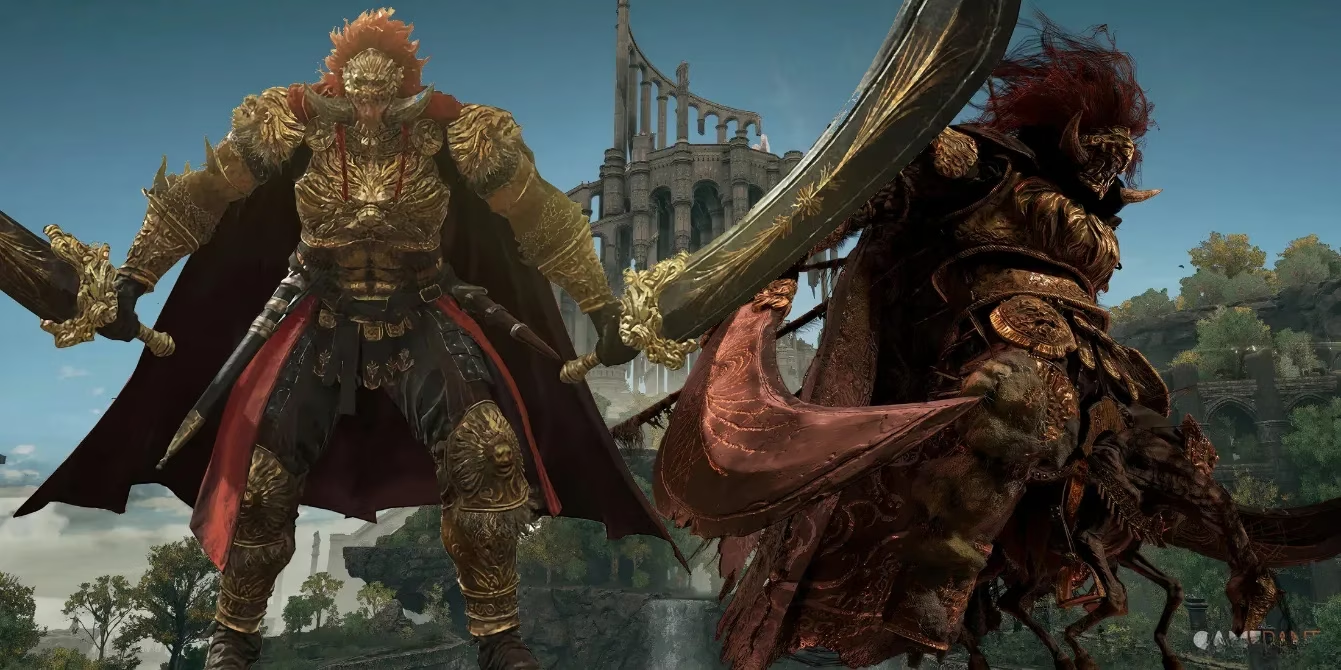
The choice of Promised Consort Radahn as the DLC's final boss, while visually stunning, ultimately functions as a narrative anti-climax. The emotional resonance is inherently stifled; players had already faced and conquered the legendary Starscourge in the base game in one of Elden Ring's most celebrated set-piece battles. Facing a restored version of him, even alongside Miquella, feels like a reprise rather than a grand finale. This repetition is akin to a master painter creating a stunning, complex mural only to sign their name in the same familiar corner as their previous work—it's technically proficient but lacks the bold, concluding statement the canvas calls for. The duo fight, while challenging, did not deliver the novel, lore-shattering conclusion that the expansion's build-up implied.
FromSoftware's DLC Legacy and the Missed Paradigm
This omission feels particularly striking when viewed through the lens of FromSoftware's own celebrated history with expansion content. Their DLCs have often been where fragmented, base-game lore finds its epic, playable culmination:
-
Artorias the Abysswalker (Dark Souls): A legend mentioned in item descriptions became a tragic, heroic boss fight.
-
Ludwig, the Holy Blade (Bloodborne): A foundational, monstrous figure of the Healing Church's history was revealed in all his horrific, yet momentarily graceful, glory.
-
Sister Friede (Dark Souls III): A entirely new, profound character story woven into the world's fabric, offering a multi-phase fight of unparalleled intensity.
Godwyn fit this paradigm perfectly. He was the enigmatic hint, the foundational tragedy. His full-fledged boss encounter in Shadow of the Erdtree was the expected payoff—the moment where the history books closed and the legend stood before the Tarnished, demanding a reckoning. Without it, his story remains an open wound in the narrative, a ghost haunting the edges of a tale that otherwise sought closure. His absence makes the DLC's ending feel like discovering the final, crucial piece of a puzzle is actually just a duplicate of one you already placed.
Conclusion: The Unfinished Requiem
In 2026, Elden Ring: Shadow of the Erdtree is remembered for its vast, challenging landscape and brutal encounters. Yet, its legacy is subtly shadowed by the path not taken. The expansion ventured to the Land of Shadow but left the most profound shadow of all—the one cast by Godwyn the Golden—unexplored in a meaningful, confrontational way. The Promised Consort Radahn fight, for all its spectacle, ultimately serves as a magnificent diversion from what could have been the true, emotionally devastating crescendo to the Elden Ring saga. The Prince of Death's potential boss fight remains one of the great "what if" scenarios in modern gaming—a missed chance to transform a lore footnote into a legendary, heartbreaking finale, leaving players with a victory that feels, in the quiet moments afterward, curiously hollow.
Leave a Comment
Comments