
Monster Hunter Wilds Needs Its Own 'Shadow of the Erdtree' Moment to Win Back Veterans
Elden Ring and Monster Hunter Wilds set new standards for expansions, blending challenge and accessibility to redefine gaming excellence.
As a long-time Monster Hunter fan who's also spent hundreds of hours in the Lands Between, I can't help but draw some major parallels between the journeys of Elden Ring and Monster Hunter Wilds. We're sitting here in 2026, and the conversation is still buzzing about what makes a great expansion. Shadow of the Erdtree wasn't just DLC; it was a seismic event in gaming, a tectonic plate shift that reset expectations. It rolled in with a Metacritic score of 94, a new map the size of a small country, 70 new weapons to obsess over, and a difficulty curve that felt like trying to summit Mount Everest in flip-flops. But more importantly, it did something for Elden Ring's legacy that Monster Hunter Wilds should be taking furious notes on. It directly addressed the base game's biggest point of contention.
Let's rewind. When Elden Ring first dropped, it was (and still is) a masterpiece. But a vocal segment of FromSoftware's hardcore veterans felt it had smoothed out too many of the brutal edges the studio was famous for. The open world, the Spirit Ashes, the accessibility—it all felt like a welcoming hand extended to newcomers, which some saw as a slight to the masochistic faithful. Fast forward two years, and Shadow of the Erdtree was the answer. It was FromSoftware's way of saying, "You wanted a challenge? Here, hold my Estus Flask." The DLC was a crucible, a trial by fire that felt like the game was actively trying to delete your save file with every new boss. While it sparked its own debate about difficulty, it was undeniable proof that the developers were listening and were willing to swing the pendulum hard in the other direction to satisfy their core audience.
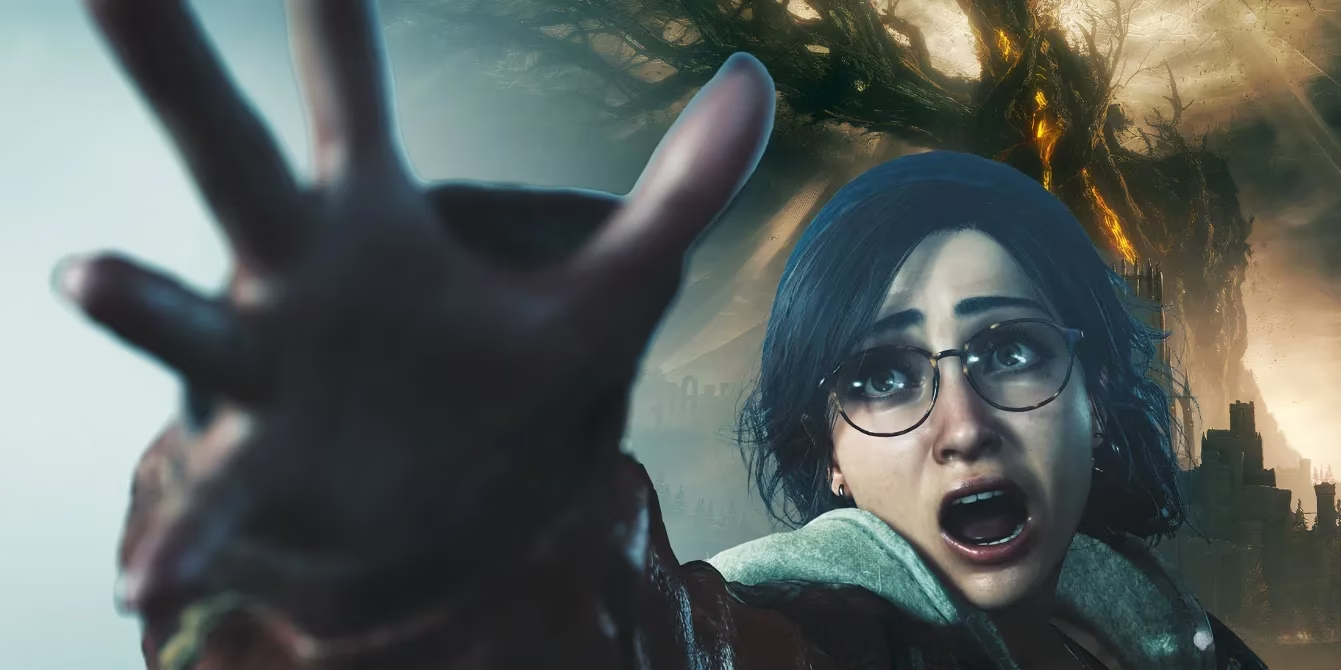
Now, look at where Monster Hunter Wilds finds itself. Since its release, it's been an incredible success. The seamless world, the riding mechanics, the sheer scale—it's a technical marvel. But, much like Elden Ring before it, it's also become arguably the most approachable entry in the franchise's history. For us veterans, this has created a weird sense of whiplash. The Monster Hunter series has always been a dance with death where the monsters lead, a beautifully brutal ballet where one misstep means a cart ride back to camp. Its difficulty wasn't in a menu slider; it was baked into the very DNA of every roar, every tail swipe, every enraged supernova.
Monster Hunter: World started this trend of wider accessibility, and Wilds has doubled down. The result? A familiar discourse has erupted. New hunters are having a blast (and they should!), while some of us old guard are left feeling like the training wheels, while helpful, are welded on a bit too tight. The thrill of the hunt, that white-knuckle, heart-pounding struggle against a creature that feels like an indomitable force of nature... it can sometimes feel diluted. The game is fantastic, but for the series' lifers, it's missing a bit of that signature, teeth-grinding spice.
This is the perfect setup. This is the "Shadow of the Erdtree" moment waiting to happen. Capcom has a golden opportunity with the inevitable Monster Hunter Wilds expansion (because let's be real, after Iceborne and Sunbreak, it's as guaranteed as a Rathalos flying into the sunset). They need to craft an expansion that does two things:
-
Serve a Challenge Worthy of Legends: The expansion's new biome shouldn't just be a new map; it should be a gauntlet, a proving ground as unforgiving as a diamondback's hide. The monsters need to be smarter, faster, and more aggressive. Their attack patterns should be complex puzzles that require not just reaction, but anticipation and deep knowledge of Monster Hunter's core mechanics. No more training wheels. This should be the content where your fully-upgraded Wilds endgame armor feels like tissue paper until you truly master the fight.
-
Deliver Substantial, Meaningful Content: It can't just be a few new monsters and an area. It needs to be a content tsunami. We're talking:
-
A massive, vertically dense new region that feels wholly alien and dangerous.
-
A roster of new and returning monsters that fundamentally change how you approach combat.
-
A slew of new weapon trees and armor sets that aren't just stat boosts, but introduce new playstyles and synergies.
-
Endgame systems that are deeper and more rewarding than anything in the base game.
-
Think about it. Shadow of the Erdtree was a mic drop that silenced critics by embracing extreme challenge. A Monster Hunter Wilds expansion that does the same could be a masterstroke. It would be Capcom saying to its veteran hunters, "We see you. We hear you. This is for you." It would rebuild that trust and cement Wilds' legacy not just as a great game, but as a complete, multi-faceted experience that caters to everyone—from the wide-eyed newcomer to the grizzled hunter who remembers when picking herbs was a commitment.
The blueprint is right there. The success story has already been written. Now, we just have to wait and see if Capcom is brave enough to pick up the pen and give Monster Hunter Wilds its own legendary, history-making expansion. My hunter's instincts are tingling... and they're saying it's time for a real hunt.
For more perspectives on the evolution of action RPGs and the latest updates in the gaming world, check out zzzverse, a dedicated hub for Zero Zone Zero and broader gaming discussions, at zzzverse.
Leave a Comment
Comments