
How Hogwarts Legacy's Sequel Could Learn from Elden Ring's World Design
Hogwarts Legacy sequel could enchant fans by integrating Elden Ring-inspired mechanics, elevating open-world action-RPG magic and exploration.
As the wizarding world action-RPG continues to captivate players well into 2026, the conversation naturally turns to what a full-blown sequel could bring to the table. Hogwarts Legacy proved that a beloved IP can thrive within an open-world action-RPG framework, delivering a story-rich experience that resonated with millions. However, looking forward, there are clear opportunities for evolution. While not a Soulslike, the game's potential successor could find incredible value by borrowing specific, immersive mechanics from titles that have reshaped the genre, particularly FromSoftware's monumental Elden Ring. Elden Ring didn't just set a new bar; it redefined player expectations for exploration, discovery, and consequence in a vast world. A Hogwarts Legacy sequel aiming to deepen its magical immersion could adapt two of Elden Ring's most memorable features in a uniquely wizardly way.
🔮 The Magic of Unexpected Journeys: Portkeys as Teleporter Traps
One of Elden Ring's most delightful (and initially terrifying) surprises was its trap chests. A player would approach a promising treasure chest, only to be engulfed in smoke and whisked across the map to a distant, often dangerous location. This mechanic created unforgettable 'Where am I?!' moments that transformed simple loot into an adventure. Hogwarts Legacy's sequel has the perfect canonical tool to adapt this: Portkeys.
In the Harry Potter universe, Portkeys are enchanted objects that transport anyone touching them to a predetermined location. A sequel could scatter these throughout the world, disguised as ordinary objects—a rusty kettle in a forbidden forest clearing, an old boot in a dungeon corner, or yes, even a suspiciously ornate chest. The key would be scarcity and surprise. They shouldn't be common; each discovery should feel significant and a bit risky.
How This Could Work in the Wizarding World:
-
The Setup: A player finds a glimmering vase in a remote cave.
-
The Twist: Upon interaction, the vase activates as a Portkey, with a swirling visual effect pulling the player into a vortex.
-
The Payoff: They land, disoriented, in a completely new region—perhaps the hidden rooftop gardens of a distant wizarding city or a secret chamber within the Ministry of Magic that was previously inaccessible.
-
The Escape: Just like in Elden Ring, there would need to be a way out, perhaps a secondary Portkey nearby or a new Floo Flame connection to unlock. This encourages the player to explore their new surroundings rather than simply fast-traveling back immediately.
This system would brilliantly encourage organic exploration. Instead of just following map markers, players would be rewarded for their curiosity with genuine discovery, sometimes leading to valuable secrets, new quest lines, or breathtaking vistas.
🗺️ Structured Mysticism: Waygates and the Floo Network 2.0
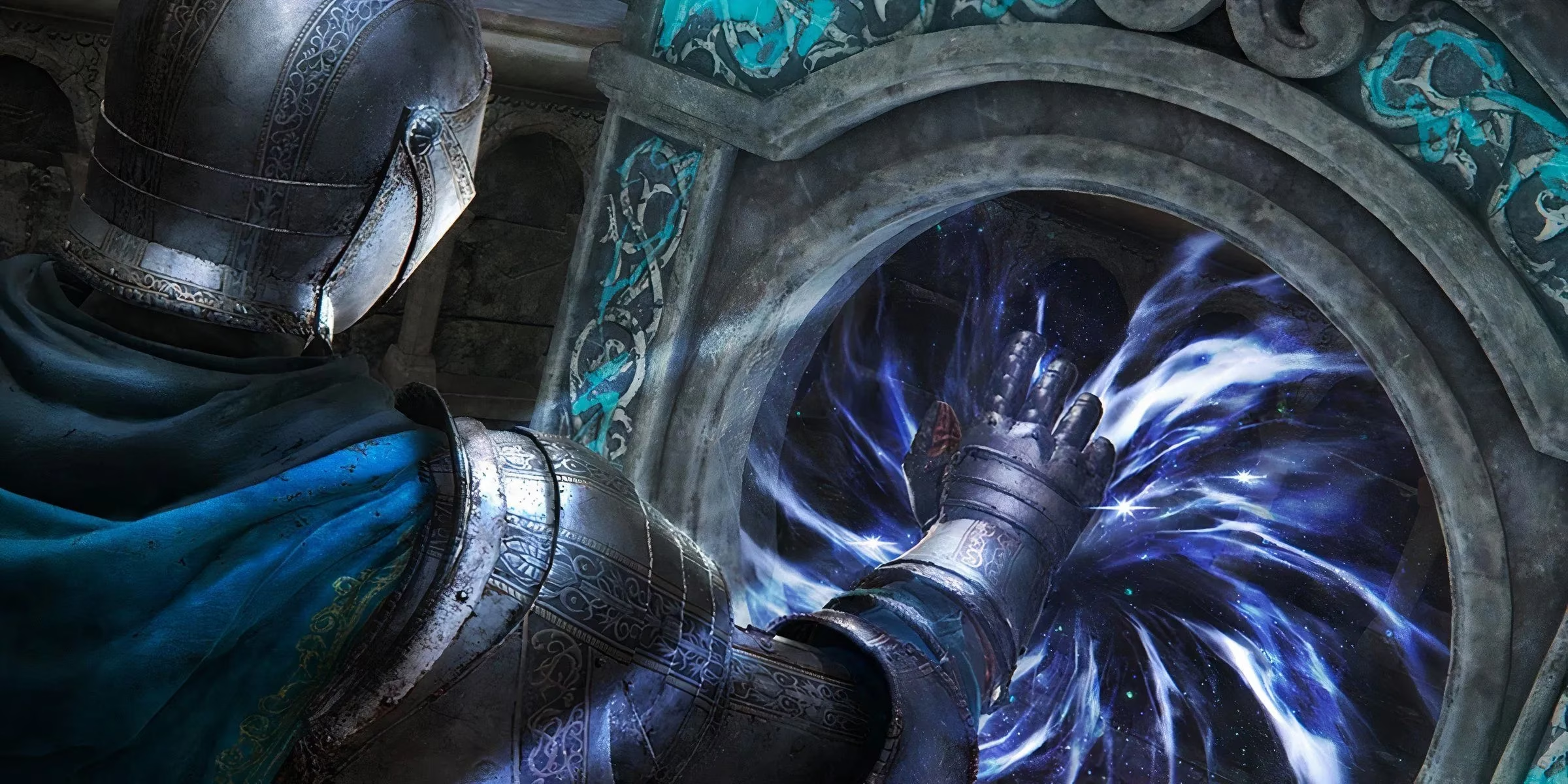
Elden Ring's waygates served as mysterious, fixed teleporters, often linking far-flung parts of the map. They were predictable in function but unpredictable in destination, acting as a structured system for unlocking long-distance travel. Hogwarts Legacy already has the Floo Flame Network, which functions similarly to Sites of Grace as fast-travel points. A sequel could expand this network by integrating a waygate-like system for truly monumental journeys.
Imagine discovering ancient, stone archways covered in runes—old magical transit systems predating Floo powder. Activating one could instantly connect two fixed points across the map, perhaps even to entirely new landmasses like the wizarding communities of Europe or Asia hinted at in the lore. This would solve a potential narrative problem: how to dramatically expand the game's world without making travel a chore.
Potential Benefits for Gameplay:
| Elden Ring's Feature | Potential Hogwarts Legacy 2 Adaptation | Player Experience |
|---|---|---|
| Waygate Teleporters | Ancient Runic Arches or Phoenix Travel Points | Unlocks a permanent, point-to-point connection between two major, distant locations. |
| Trap Chest Teleports | Disguised Portkeys (as described above) | Creates moments of surprise, danger, and unplanned exploration. |
| Site of Grace (Checkpoint) | Floo Flame Nexus (expanded) | Provides safe havens, progression saving, and hub-based fast travel. |
By combining a reliable system (Floo Network/Runic Arches) with an unpredictable one (Portkey traps), the game world would feel both cohesive and wildly magical. Players could plan grand expeditions using the reliable networks, but still stumble into life-changing detours through magical accident.
✨ Beyond Travel: Building a Living, Reactive Magical World
The true lesson from Elden Ring isn't just about specific mechanics, but about philosophy. Its world feels ancient, indifferent, and full of secrets that don't care if you find them. A Hogwarts Legacy sequel that adopts this 'show, don't tell' approach for its magical artifacts would be profoundly immersive.
The sequel is expected to introduce a plethora of iconic items, spells, and creatures the first game didn't have time for. Instead of simply handing these out via quests, why not hide them in the world governed by these new travel mechanics?
-
A trapped Portkey might deposit a player right in front of a Thestral herd, unlocking a new creature companion opportunity.
-
An ancient waygate might lead to a secluded valley where the secret to casting a powerful, forgotten spell is etched into the stones.
-
The journey back from an unexpected teleportation could itself become a memorable survival challenge, forcing the player to use their full repertoire of spells in new ways.
In essence, travel becomes more than a menu screen—it becomes narrative. By learning from Elden Ring's masterful world design, a Hogwarts Legacy sequel could transform its magical universe from a beautiful backdrop into an active, mysterious, and endlessly surprising character in its own right. The foundation is already there; it just needs a dash of daring, unpredictable magic.
Leave a Comment
Comments