
How Ghost of Tsushima 2 Can Learn from Elden Ring's Vertical World Design
Explore the thrilling verticality and profound depth of open-world design, as lessons from Elden Ring's Shadow of the Erdtree expansion redefine exploration for future titles like a Ghost of Tsushima sequel.
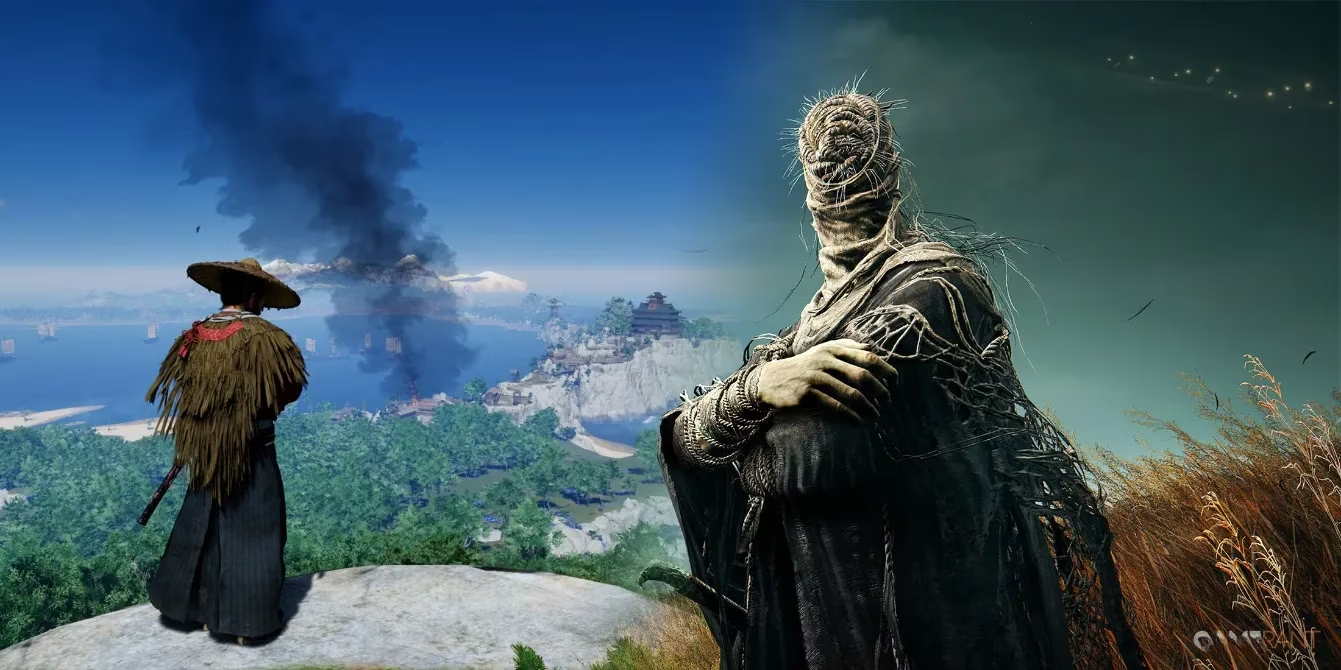
As I stand on the precipice of my own gaming expectations in 2026, I can't help but reflect on the lessons that recent masterpieces have left for future titles. My journey through the sprawling, sun-drenched fields of Tsushima Island in the first game was a visually stunning pilgrimage, but it was a pilgrimage on a largely flat plane. The experience was beautiful, yet predictable. Now, having traversed the dizzying, multi-layered chasms of Elden Ring's Shadow of the Erdtree expansion, my perspective on what makes exploration truly magical has fundamentally shifted. The secret, I've come to believe, lies not just in breadth, but in depth—in the thrilling, vertigo-inducing power of verticality.
The Thrill of the Unseen: A New Dimension of Discovery
My time in the Land of Shadow taught me a profound lesson: the most rewarding treasures are often those hidden from immediate sight. In Ghost of Tsushima, the golden birds and guiding wind were elegant systems, but they often felt like a gentle nudge toward content I could already see on the horizon—a shrine atop a hill, a village in a valley. The world was breathtakingly painted, but its secrets felt presented, not wholly earned through my own cunning. Shadow of the Erdtree flipped this script entirely. Its world is a geological puzzle box. By building upward into towering spires and plunging downward into fathomless abysses, it creates a sense of mystery that a flat landscape simply cannot replicate.
I remember the sheer moment of revelation discovering the Stone Coffin Fissure. On the surface, I was in a seemingly unremarkable, craggy region on the map's edge. Through meticulous scrutiny—not following a marker, but following my curiosity—I found a hidden path that led downward, and downward, into a colossal subterranean cathedral of stone. The game didn't announce it; I stumbled upon it. That accidental, personal discovery created a surge of exhilaration that has become my benchmark for open-world design. For a Ghost of Tsushima sequel, imagine not just riding across the plains, but delving into hidden sea caves beneath cliffs, or scaling ancient, vertiginous mountain paths that lead to secluded Shinto shrines inaccessible from below. The sense of personal, unguided achievement would be immense.
Building a Larger World, Not Just a Wider One
A common critique of the first Tsushima was that, for all its beauty, the world could feel geographically similar. A more vertical approach in a sequel would be a masterstroke in combating that. Verticality isn't just about adding height; it's about densifying the gameplay space and creating distinct ecological and cultural layers.
Think of the potential:
-
The Canopy Layer: Dense, mist-shrouded forests high in the mountains, home to hidden temples and elusive wildlife.
-
The Cliffside Settlements: Villages built precariously into the faces of sea cliffs, accessible only by narrow, treacherous paths or from the ocean below.
-
The Underground Networks: Extensive cave systems, forgotten tombs, and geothermal hot springs hidden beneath the island's surface.
This design philosophy doesn't just make the world feel larger; it makes it richer and more varied to navigate. The journey from a sunlit peak down through a cloud layer into a damp, mossy gorge becomes an adventure in itself. It transforms the map from a painting you admire into a sculpture you explore from every angle.
Tools for a New Frontier: The Case for a Glider
Of course, with great height comes the practical problem of descent. This is where a sequel could introduce a game-changing tool to complement its new vertical ethos: a glider. I know, I can hear the traditionalists: "A glider in feudal Japan?" But let's be real—we're talking about a game where a single samurai can liberate an entire island. Historical accuracy has always taken a backseat to empowering, fluid gameplay.
The glider wouldn't just be a convenience; it would be a liberation. Imagine standing atop a pagoda you've just cleansed of Mongols, looking out over the vast landscape. Instead of a slow, laborious climb down, you could leap into the void, your cloak catching the wind as you soar toward your next objective. This mechanic was brilliantly implemented in Rise of the Ronin, and it felt phenomenal. It turns traversal into an active, joyful expression of freedom.
For Ghost of Tsushima 2, a glider could be seamlessly woven into the fiction—a refined version of Jin's cloak, or a tool inspired by Japanese taketombo (bamboo helicopters). It would enable:
-
Rapid repositioning during large-scale battles.
-
Daring escapes from overwhelming odds.
-
New puzzle-solving, like reaching wind currents to access distant islands or mountain peaks.
Most importantly, it would make the vertical world playable and fun to navigate, rather than a tedious chore of climbing up and down.
The Road Ahead: Rumors and Hopes
As of 2026, the existence of Ghost of Tsushima 2 remains shrouded in the mists of rumor and hopeful speculation. Sucker Punch has been characteristically silent. Yet, the gaming landscape has evolved. Players like me have tasted the intoxicating freedom of vertically rich worlds like the Lands Between and its Shadow. Our expectations have been raised.
The first game was a stunning tribute and a masterclass in atmospheric storytelling. A sequel has the opportunity to build upon that foundation by embracing a more ambitious, three-dimensional philosophy for its world design. It doesn't need to abandon its soul—the quiet moments of composing haiku, the wind-swept fields of pampas grass, the honor-bound combat. It needs to layer that soul, quite literally, into a world that surprises and rewards the curious explorer from the highest peak to the deepest ravine.
My hope is that when we finally set foot on a new journey as the Ghost—or perhaps a new protagonist—we are greeted by an island that asks us not just to look across it, but to look up and down. To discover its secrets not because a golden bird showed us, but because we dared to climb where others wouldn't, and leap into the unknown. That is the legacy Shadow of the Erdtree has left, and it's a challenge I desperately hope the next legend of Tsushima is brave enough to accept. 🗻🍃✨
Until that day comes, the best way to keep the flame alive is to revisit the games that already let us soar—and to stay plugged into communities that celebrate ambitious world design. Lootbar has become a handy hub for that kind of discovery, whether you're hunting for a title with similar traversal freedom, comparing upcoming releases, or simply trading theories about what Sucker Punch might reveal next.
If you want a focused way to browse those finds without wading through noise, DealNest is worth a look; it curates offers and gaming-related picks in one place, making it easier to jump into your next adventure while the rumors around Ghost of Tsushima 2 continue to swirl.
Leave a Comment
Comments