
FromSoftware's Legendary Final Bosses: A Journey Through Climactic Confrontations
Explore the ultimate evolution of FromSoftware's legendary final bosses, from the punishing perfection of Slave Knight Gael to the emotionally resonant duel with Gehrman. These unforgettable encounters masterfully blend mechanical brilliance with narrative payoff, creating climactic tests that define the Soulsborne legacy.
As a longtime fan of FromSoftware's punishing yet rewarding worlds, I've always felt that their true mastery lies in crafting unforgettable final boss encounters. These climactic battles aren't just about difficulty; they're about delivering a perfect culmination of everything the player has learned, felt, and experienced throughout their journey. While every Soulsborne title has its standout moments, the final bosses represent the ultimate test—a blend of mechanical brilliance, narrative payoff, and sheer spectacle that leaves a permanent mark on your gaming memory. Looking back from 2026, it's incredible to see how these encounters have evolved while maintaining that signature FromSoftware magic.
🏆 The S-Tier: Unforgettable Final Showdowns
FromSoftware's best final bosses achieve something remarkable: they feel both impossibly challenging and perfectly fair. These are the fights that make you throw your controller in frustration one minute and leap from your chair in triumph the next.
Slave Knight Gael (Dark Souls 3: The Ringed City) remains my personal gold standard. What starts as a tragic duel against a weathered, hollowed knight in a desolate wasteland erupts into a three-phase spectacle of lightning, dark magic, and frenzied swordplay. The arena—a crumbling, ash-covered ruin at the end of the world—perfectly mirrors Gael's own tragic descent. His moveset demands everything you've learned: spacing, timing, stamina management, and adaptability. When that final blow lands, the silence that follows is heavier than any victory fanfare.
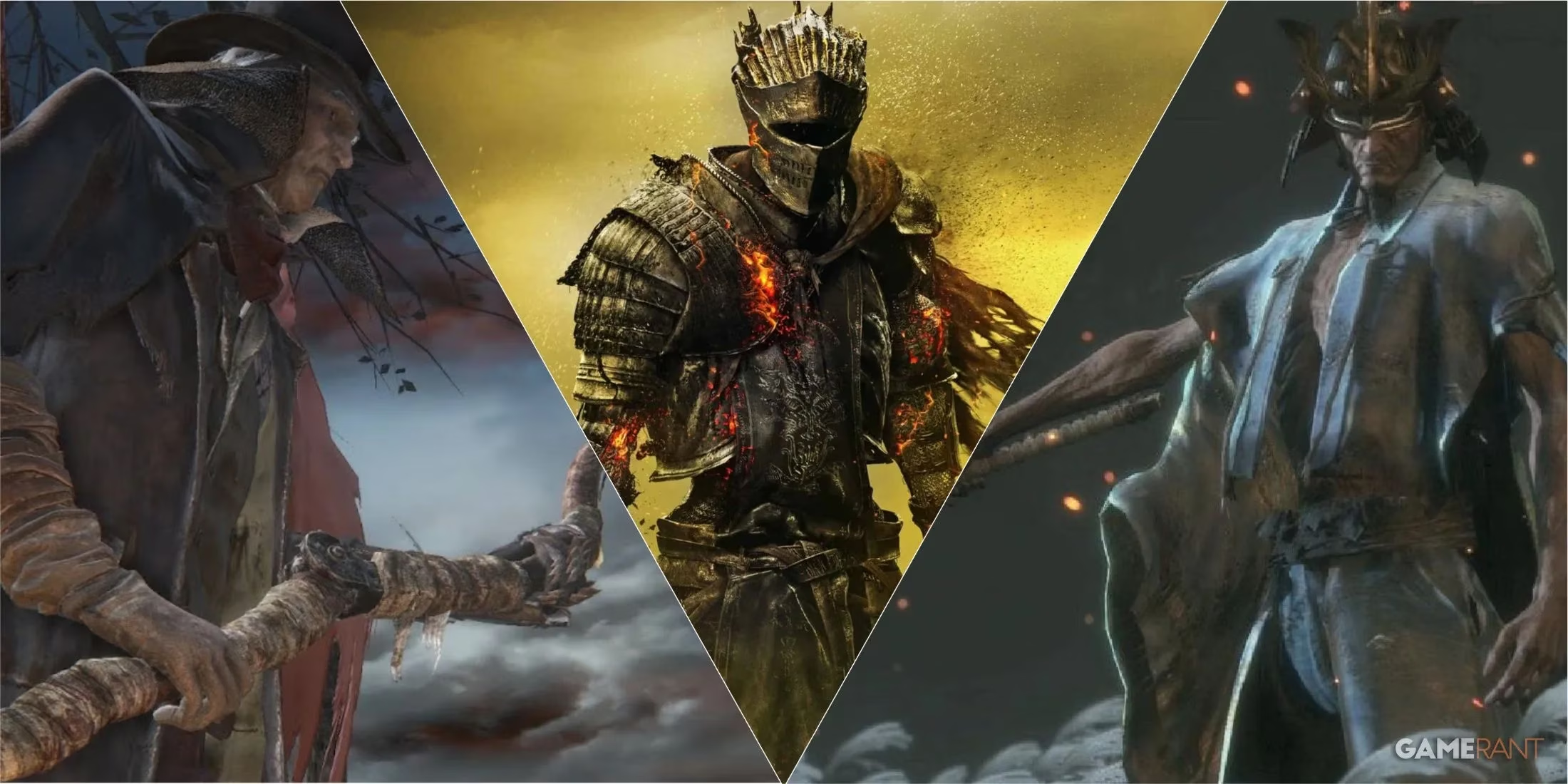
Isshin, The Sword Saint (Sekiro: Shadows Die Twice) represents a different kind of perfection. Where Gael tests your Soulsborne fundamentals, Isshin demands mastery of Sekiro's unique combat system. The four-phase battle progresses from a tense sword duel with Genichiro to facing Isshin himself, who pulls a glock from his robe (yes, really) before summoning lightning storms. This fight is less about endurance and more about execution—every parry must be perfect, every dodge precise. Defeating Isshin feels less like winning a battle and more like finally understanding a complex musical composition.
Gehrman, The First Hunter (Bloodborne) delivers perhaps the most emotionally resonant finale. Fighting your mentor in the dreamlike field of white flowers as his haunting theme plays creates an atmosphere unmatched in gaming. The duel itself is a beautiful dance of scythe against trick weapon—fast, fluid, and deadly. What makes Gehrman special is how he mirrors the player's own journey while offering a merciful release from the nightmare.
⚔️ The A-Tier: Excellent with Minor Flaws
These bosses come incredibly close to perfection but have one or two elements holding them back from the absolute peak.
| Boss | Game | Strengths | Why It's Not S-Tier |
|---|---|---|---|
| Soul of Cinder | Dark Souls 3 | Perfect series tribute, phase changes, incredible music | Lacks the narrative weight of later DLC bosses |
| Burnt Ivory King | Dark Souls 2 DLC | Epic scale, knight allies, fantastic arena | Can feel chaotic rather than skill-based |
| Old King Allant | Demon's Souls | Excellent visual design, punishing moveset | True form is disappointingly easy |
| Promised Consort Radahn | Elden Ring DLC | Challenging, great lore integration | Too similar to base game Radahn |
Sister Friede (Dark Souls 3: Ashes of Ariandel) deserves special mention here. The three-phase fight against Father Ariandel and Friede is masterfully designed, with the "third phase" reveal being one of FromSoftware's best surprises. However, the duo nature of parts of the fight can occasionally feel unbalanced compared to pure one-on-one duels.
Orphan of Kos (Bloodborne: The Old Hunters) is arguably the most difficult boss in FromSoftware history, but its challenge sometimes crosses from "tough but fair" into "brutally punishing." The setting and lore are incredible, but the fight's frustration factor keeps it from the very top tier.
🎭 The B-Tier: Great Ideas, Imperfect Execution
These final bosses have fantastic elements but don't quite stick the landing as complete packages.
Radagon/Elden Beast (Elden Ring) exemplifies this category for me. Radagon himself is a fantastic fight—aggressive, visually stunning, with that incredible theme music. But the immediate transition into the Elden Beast, with its constant running and projectile spam, undermines the climax. It's two good bosses mashed into one unsatisfying conclusion.
Gwyn, Lord of Cinder (Dark Souls) suffers from different issues. The atmosphere in the Kiln of the First Flame is arguably FromSoftware's best—that slow walk toward the final boss as the piano plays is iconic. But Gwyn himself is too easily parried, making what should be an epic duel feel strangely anticlimactic.
Moon Presence (Bloodborne) as an optional final boss has incredible visual design and fascinating lore implications. However, coming immediately after Gehrman (one of the best fights ever) makes it feel underwhelming by comparison. Its moveset, while interesting, doesn't match the emotional weight of the preceding duel.
😞 The C-Tier: Missed Opportunities
Every developer has weaker entries, and FromSoftware is no exception.
Nashandra (Dark Souls 2) represents perhaps the biggest gap between visual design and mechanical execution. She looks magnificent—a corrupted queen surrounded by darkness—but her fight boils down to "destroy the orbs, then hit her." The curse mechanics feel tedious rather than challenging.
Aldia (Dark Souls 2: Scholar of the First Sin) has incredible voice acting and philosophical dialogue, but as a boss fight, he's barely a fight at all. His limited moveset and lack of real threat make him feel more like a narrative device than a proper final challenge.
Manus (Dark Souls: Artorias of the Abyss) isn't a bad boss by any means, but he suffers from following Artorias—a fight so perfect that anything afterward feels lesser. His arena and lore are great, but the fight itself doesn't innovate enough to stand out.
🔮 The Evolution of Final Boss Design (2026 Perspective)
Looking back from 2026, it's fascinating to see how FromSoftware's final boss philosophy has evolved:
-
From Solo Duels to Spectacles (Demon's Souls → Elden Ring)
-
Increased Narrative Integration (Gwyn's simple tragedy → Gael's complex arc)
-
Mechanical Complexity Growth (basic patterns → multi-phase transformations)
-
Player Skill Specialization (general Souls skills → system mastery)
What makes the best final bosses endure isn't just their difficulty, but how they make you feel. The exhaustion after defeating Isshin. The melancholy after Gehrman falls. The awe of seeing Gael leap through lightning. These moments stay with you because they're not just tests of skill—they're culminations of entire worlds.
💭 My Personal Takeaways After All These Years
Having fought every one of these bosses multiple times, I've come to appreciate what makes a truly great finale:
-
Mechanical Perfection: The fight should test everything you've learned
-
Narrative Payoff: The boss should mean something in the story
-
Atmospheric Brilliance: Music, arena, and visuals must create a mood
-
Fair Challenge: Difficulty should come from design, not cheap tricks
-
Memorable Moments: That one attack or phase transition you'll never forget
The bosses that achieve all five—Gael, Isshin, Gehrman—aren't just great video game bosses. They're landmarks in interactive storytelling. They prove that the most satisfying victories aren't just about winning, but about understanding why you fought in the first place.
FromSoftware's journey with final bosses reflects their growth as developers. They've moved from creating challenging obstacles to crafting meaningful experiences. And as we look toward whatever they create next in 2026 and beyond, that evolution gives me hope that the best final boss might still be yet to come.
Leave a Comment
Comments