
FromSoftware's Future: Why Armored Core Deserves Its Own Elden Ring-Style Spin-Off Treatment
FromSoftware's evolution shines through Elden Ring's blockbuster success and Armored Core 6's mech mastery, heralding a bold future for RPGs.
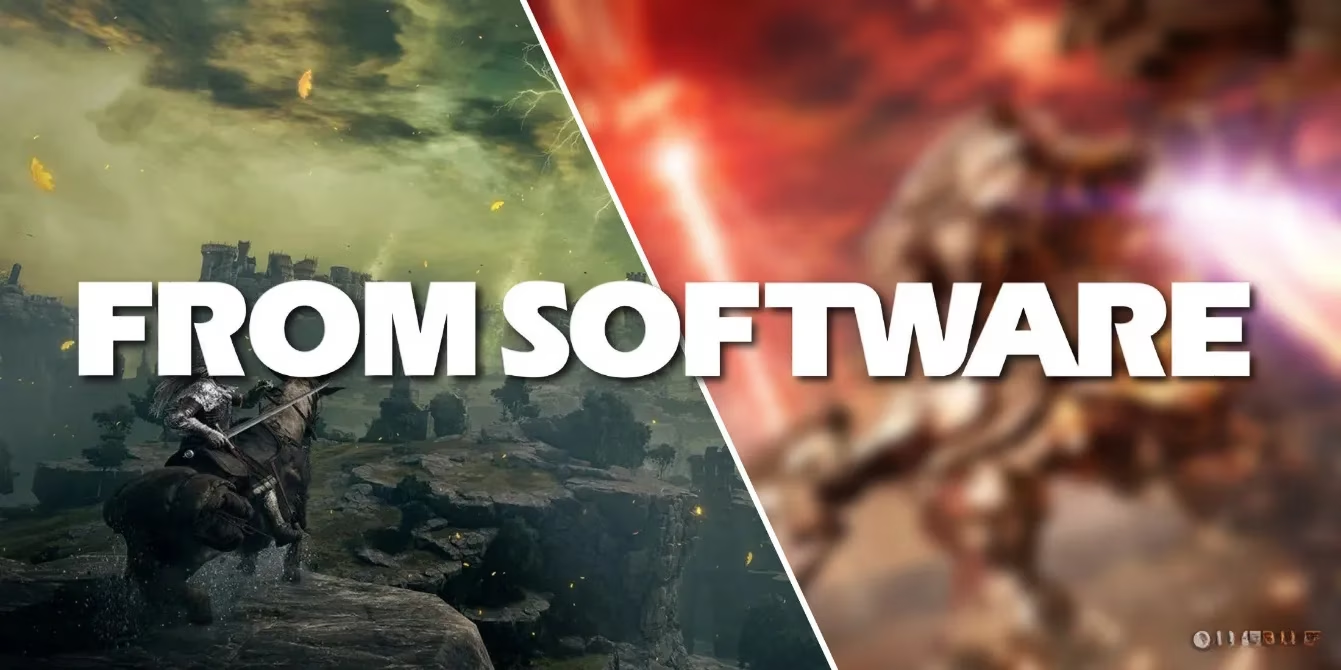
As a longtime fan who has weathered the punishing landscapes of Lordran and braved the shimmering, treacherous skies of Rubicon, I've watched FromSoftware evolve from a cult favorite into a household name. The seismic success of Elden Ring in 2022 was like watching a dormant volcano finally erupt, showering the gaming world in molten gold and redefining what a blockbuster RPG could be. Its shadow, both literal with the 'Shadow of the Erdtree' expansion and figurative, is long. Yet, as I sit here in 2026, reflecting on the studio's journey, my mind keeps drifting back to the metallic roar of boosters and the calculated dance of mech combat. While the Lands Between captured the world's imagination, it's the recently revitalized Armored Core 6: Fires of Rubicon that has me pondering a different, equally exciting future for FromSoft. The studio has mastered the art of the sprawling dark fantasy epic, but its true next frontier might lie in taking its other beloved child, Armored Core, on a bold, genre-defying detour.
The Elden Ring Phenomenon and the Sequel That Isn't
Let's be real: Elden Ring wasn't just a game; it was a cultural reset. Selling over 13.4 million copies in its first few weeks was like a fantasy novel protagonist discovering they were the chosen one all along—sudden, overwhelming, and world-changing. The expansion, 'Shadow of the Erdtree,' proved this was no fluke, landing with the same thunderous applause. Yet, in a move that surprised many, the legendary director Hidetaka Miyazaki himself confirmed that FromSoftware isn't actively planning an 'Elden Ring 2.' He left the door open, however, for the IP to expand in other ways. This statement felt less like a closed gate and more like a master cartographer pointing to blank spaces on a map, hinting at unseen lands. The studio's strategy seems to be one of creative cultivation, not just sequel farming.
Armored Core 6: The Quiet Triumph
While the Tarnished were conquering the Erdtree, a different kind of pilot was igniting the fires on Rubicon. Armored Core 6's release last year was a triumphant return for a series that had been silent for a decade. It didn't shatter cultural consciousness like Elden Ring—it was more like a precision orbital strike than a continent-altering cataclysm. But its success was undeniable:
-
Commercial Victory: It became the best-selling title in the series' nearly 30-year history, moving about 3 million copies worldwide in under a year.
-
Critical Acclaim: It was praised for its deep customization, blistering combat, and that signature FromSoftware challenge.
-
Proven Potential: It demonstrated that there is a massive, hungry audience for high-quality mech action beyond the series' traditional niche.
This success wasn't a random asteroid strike; it was the result of a meticulously engineered reactor reaching critical mass. It proved the IP has immense latent power.
A History of (Mostly) Straight Lines
For all its longevity, the Armored Core series has been remarkably consistent in its core identity. It's a third-person mecha shooter, through and through. The mission structure, the garage customization, the arena combat—these are its foundational pillars. There have been slight deviations, of course. Titles like Armored Core: Nine Breaker and Formula Front (2004) focused more on arena tournaments and tuning, and a handful of mobile games existed in Japan, but they were still, at their heart, mech combat sims. The core gameplay loop has been as focused as a sniper's laser sight. This consistency is a strength, but in 2026, with a studio now famous for ambition, it also feels like a frontier waiting to be crossed.
The Case for a Genre-Bending Spin-Off
Miyazaki-san has already revealed that FromSoftware is working on multiple new projects across various genres. The studio is stretching its creative muscles. So, why not apply that same innovative spirit to Armored Core? The idea isn't to replace the mainline, fast-paced shooter entries, but to complement them—to build out the universe.
Imagine an Armored Core Tactical RPG. Picture the deep, strategic turn-based combat of a modern Front Mission, where positioning, terrain, and part targeting matter as much as firepower. You'd command a lance of customized ACs, managing resources and relationships with corporations on a war-torn world. The customization wouldn't just be for stats; your mech's loadout would directly dictate its role on the hex-based battlefield—a long-range artillery piece, a close-quarters brawler, or a nimble scout. The corporate intrigue and dystopian settings of Armored Core are a perfect fit for a narrative-driven, strategic experience.
Or, consider a Character Action Spin-Off. What if we stepped out of the cockpit? FromSoftware already has the bonkers blueprint of Metal Wolf Chaos. Now, imagine a game where you play as an augmented Raven, fighting on foot and in lighter, more agile powered frames within the massive industrial sprawls of an AC universe city. The combat could blend the weighty precision of Sekiro with high-tech gadgetry and acrobatics, offering a ground-level view of a world usually seen from 10 meters up. It would be a chance to explore the human (or augmented) cost of the perpetual corporate wars.
Why This Makes Sense Now
-
Capitalizes on AC6's Momentum: The player base is here, engaged, and hungry for more content in this universe. A spin-off could attract fans of other genres who were intrigued by the world but hesitant about the shooter gameplay.
-
Demonstrates Creative Range: It would show that FromSoftware can innovate wildly within its own established IPs, not just between them. An AC strategy game would be as distinct from AC6 as Bloodborne was from Dark Souls.
-
Expands the Audience: A turn-based tactics game or a character action title could draw in entirely new crowds, acting as a gateway to the main series. The universe becomes a hub, not a single road.
-
Fulfills the Elden Ring Philosophy: Elden Ring's approach was "open world, but make it ours." An Armored Core spin-off's philosophy could be "new genre, but make it ours." Infuse it with that signature FromSoftware depth, atmosphere, and uncompromising quality.
For some purists, the idea might seem as outlandish as a Moonlight Greatsword in a gunship duel. But FromSoftware has built its legacy on defying expectations. Elden Ring taught us that their worlds are vast tapestries, rich with untold stories and unexplored angles. Rubicon and its legacy corporations are such a tapestry. The success of AC6 has re-ignited the franchise's core reactor. Now is the perfect time to channel that energy into something unexpected—to let Armored Core, like a mech shifting into its ultimate transformation, evolve into forms we haven't yet dreamed of. The future isn't just about returning to the Lands Between; it's about discovering what new kinds of battles can be fought in the ashes of Rubicon.
Leave a Comment
Comments