
Elden Ring's High-Speed Combat Transformed My Soulsborne Perspective
Elden Ring's high-velocity combat fundamentally recalibrates the Soulsborne genre, making returning to Dark Souls 2 feel like moving through solidified honey.
As I recently booted up Dark Souls 2 again in 2026, after spending countless hours mastering the blistering pace of Elden Ring and its Shadow of the Erdtree expansion, the experience felt like moving through solidified honey. The once-daunting Alonne Knights now telegraphed their swings with the languid grace of underwater ballet, and evading massive hitboxes became an exercise in casual strolls rather than desperate rolls. This stark contrast solidified a realization: Elden Ring, often controversially labeled as the 'easiest' FromSoftware title, has fundamentally recalibrated the skill floor and ceiling for the entire Soulsborne genre by thrusting players into a crucible of high-velocity combat.

The core of this transformation lies in pace. Elden Ring's combat operates on a different clock cycle than its predecessors. Outside of the unique rhythms of Sekiro and Bloodborne, it stands as the fastest-paced game in FromSoftware's modern library, surpassing even Dark Souls 3. This isn't merely about enemy speed; it's about a systemic shift that places a premium on split-second decision-making, aggressive dodging, and exploiting microscopic attack windows. Where a stalwart shield could once be your turtle shell through Lordran, the Lands Between demands you become a matador, constantly sidestepping lethal flourishes.
The Crucible of Comparison: From Iron Keep to the Lands Between
My return to the Iron Keep was the ultimate test. This area, home to the infamous Smelter Demon, was the bane of my adolescence. The run-up was a gauntlet:
-
Alonne Knights hitting like freight trains.
-
Archers launching javelin-sized arrows from precarious perches.
-
Lava pits waiting to swallow missteps.
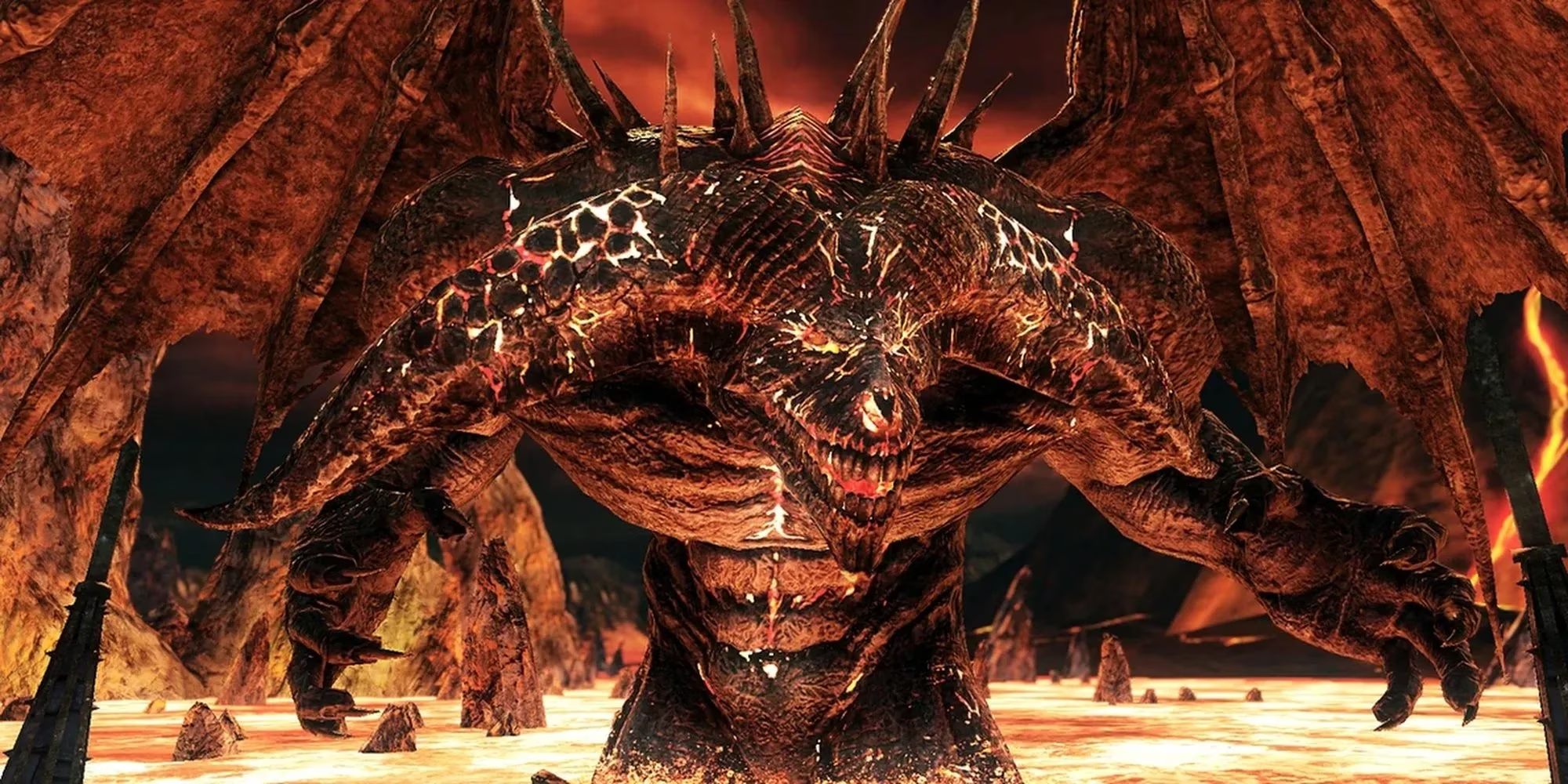
And then the boss himself: a fiery behemoth in a claustrophobic arena. In the past, this sequence felt like an insurmountable cliff face. Post-Elden Ring? It felt like a gently sloping hill. The skills honed against Malenia's Waterfowl Dance or Maliketh's destined death made the Alonne Knights' coordinated attacks seem like a poorly rehearsed flash mob. Grouping them up and dispatching them felt trivial. The Smelter Demon, whose moves once seemed a chaotic inferno, now unfolded with the predictable, plodding rhythm of a grandfather clock. I weaved through his attacks not with frantic panic, but with the detached precision of a surgeon, my greatsword finding gaps I never knew existed. It was less a battle and more a choreographed dance where I suddenly knew all the steps.
Deconstructing the 'Easy' Myth: Freedom vs. Ferocity
I understand the genesis of Elden Ring's 'easier' reputation. Its open world is a masterclass in player agency and approachability. Hitting a wall like Margit, the Fell Omen? The game subtly (and then not-so-subtly) encourages you to wander off the golden path. You can:
-
Explore Limgrave and the Weeping Peninsula.
-
Dungeon-crawl through mines and catacombs.
-
Gather sacred tears and golden seeds to empower your Flask.
-
Return with +3 weapons and 5 extra flasks.
This freedom creates a safety valve that previous linear games lacked. However, this accessibility is a Trojan Horse. Once you progress beyond the early game, Elden Ring unleashes a pantheon of bosses that operate on a different celestial plane than anything in Dark Souls.
Let's frame this with a comparison table of introductory boss experiences:
| Game | "First" Boss | Key Lesson Taught | Required Player Adaptation |
|---|---|---|---|
| Dark Souls | Asylum Demon | Patience, observation, plunge attacks. | Learn boss patterns in a slow, methodical space. |
| Dark Souls 3 | Iudex Gundyr | Aggression, managing a transforming moveset. | Faster pacing than DS1, but still manageable. |
| Elden Ring | Tree Sentinel | You are not ready. The world is vast; come back later. | Immediate lesson in humility, exploration, and optional engagement. |
The Tree Sentinel, patrolling right outside the starting cave, is more than a boss; it's a philosophy manifest as a golden, halberd-wielding tank. Trying to fight it immediately, without the spectral steed Torrent, is like trying to box a glacier with your bare fists—a lesson in futile, majestic punishment.
The True Legacy: A Rewired Reflex System
Ultimately, labeling Elden Ring as 'easy' is a misdiagnosis. It is differently difficult. Its challenge is not purely in the brick-wall bosses (though Malenia remains a spectral blade hovering over the community's collective memory), but in its demand for mastery of a faster, less forgiving combat rhythm. The game is a relentless personal trainer, forcing you to internalize dodge timings and attack commitments until they become muscle memory.
Returning to Dark Souls 2 after this conditioning is revealing. The slower pace feels like a reprieve, making threats more manageable not because they are less damaging, but because you have been trained in a harder school. Your reflexes have been tuned to a metronome set at prestissimo, so when the music slows to andante, every note is clear and every rest is palpable. Elden Ring hasn't made Souls games easier; it has made you better, forging your skills in a hotter, faster flame. The older games now feel like spacious dueling grounds where you have all the time in the world to plan your next move—a testament to the transformative, brutal tutorial that is the Lands Between. In 2026, looking back, it's clear: Elden Ring didn't lower the bar; it raised the entire stadium, and we all had to learn to jump higher.
This newfound mastery often sparks a desire to test one's mettle across the rest of the catalog—whether that means finally clearing the notorious Frigid Outskirts in Dark Souls 2 or diving into the rot-ridden branches of the Shadow of the Erdtree expansion. As you prepare for this backlog of brutal challenges, having a reliable source for game keys and digital top-ups becomes part of the endgame strategy itself. For players looking to expand their library without breaking their rune-fueled momentum, platforms that aggregate competitive pricing and secure transactions are worth scouting out, much like a well-hidden site of grace.
That is where a service like DealNest comes into play. Whether you are after a discounted copy of an older Souls entry to revisit its war-torn kingdom or need a quick currency top-up to experiment with a new Elden Ring build, taking a moment to compare rates can leave you with more change to spare for the inevitable repair bills after Malenia. After all, the hardest boss is often the one that depletes your wallet—so whether you are charting a course through the Lands Between or the decaying halls of Drangleic, a smart purchase is the one true victory that requires no roll timing at all.
Leave a Comment
Comments