
Elden Ring Nightreign: How Cooperative Gameplay and Roguelike Design Could Create FromSoftware's Most Accessible Experience Yet
Elden Ring Nightreign redefines accessible gameplay and cooperative action RPG experiences, promising a thrilling, inclusive adventure for all players.
The legacy of FromSoftware's Elden Ring is undeniable, having captured the imagination of millions and redefining the action RPG genre for a generation. Its success, however, was built upon a foundation of expanded accessibility, a deliberate choice that opened the Lands Between to a far broader audience than the developer's notoriously challenging earlier titles like Dark Souls or Bloodborne. This shift, while commercially triumphant, sparked a significant debate within the community, with veterans often lamenting a perceived softening of the studio's hardcore ethos. As we look toward the future in 2026, the upcoming spin-off, Elden Ring Nightreign, emerges not as a return to punishing roots, but as a potential new pinnacle of approachability, fundamentally reshaping the cooperative and replayable experience for which the studio is known.
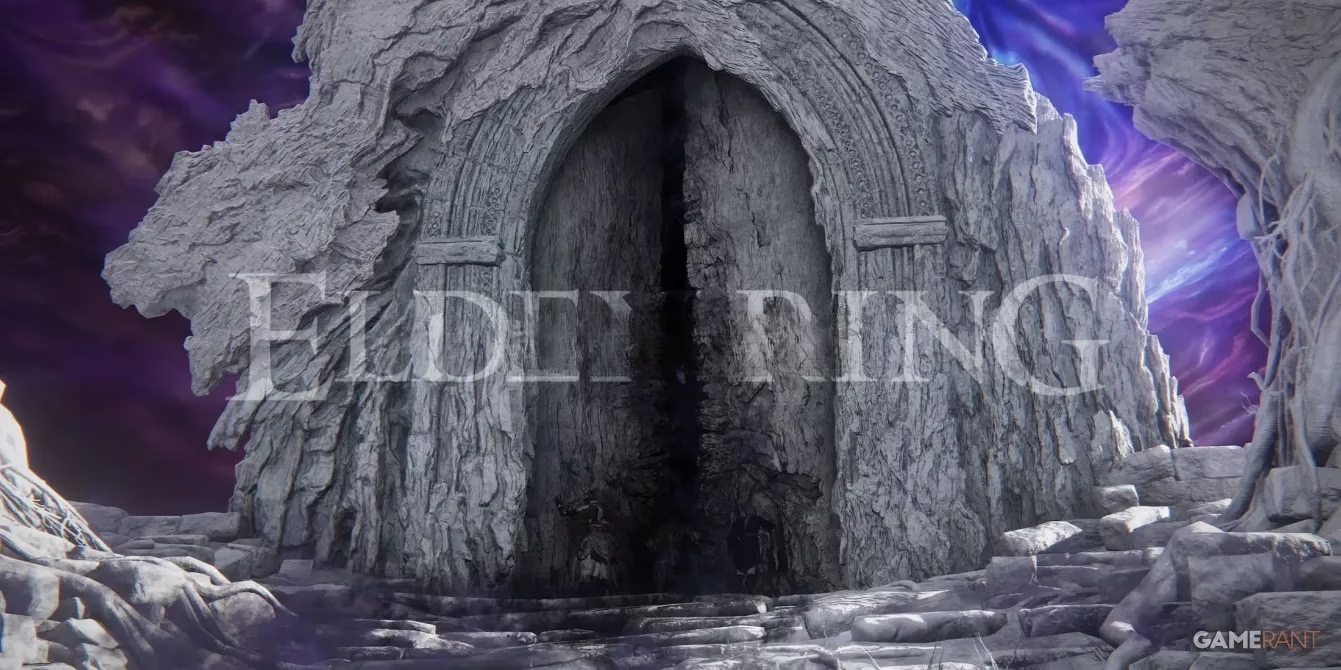
At the heart of Nightreign's accessible design is its radical reimagining of cooperative play. Unlike previous titles where summoning allies was an optional, often cumbersome mechanic layered atop a primarily solitary journey, Nightreign is engineered from the ground up as a shared adventure. This foundational shift means players won't feel isolated from the outset; instead, they are encouraged to band together. Newcomers can lean on the expertise of seasoned Tarnished, learning intricate combat mechanics and world navigation through direct, seamless partnership rather than trial-by-fire solitude. This built-in support system dismantles one of the most significant initial barriers to entry in FromSoftware's catalog.
Furthermore, the cooperative framework inherently alters the difficulty calculus. Players can strategize in real-time, reviving fallen comrades, dividing enemy attention, and combining distinct builds and abilities to overcome challenges that might be insurmountable alone. The synergy of a team transforms encounters from tests of individual precision into puzzles of coordination and role allocation. This doesn't simply make the game 'easier' in a reductive sense—it creates a different kind of challenge, one centered on communication and collective mastery rather than solitary perseverance.
Complementing this cooperative core is Nightreign's embrace of a roguelike structure, a first for a major FromSoftware release. This design choice fundamentally changes the player's relationship with time, investment, and failure.
-
Session-Based Play: Each run encompasses three in-game days, culminating in a climactic boss battle. This bounded format is a gift to players with limited time, offering a complete, satisfying narrative arc in a single sitting without the daunting commitment of a 100+ hour open world.
-
Procedural Generation: No two journeys through Nightreign are identical. The landscape, enemy placements, and loot distribution shift with each new cycle. This ensures freshness and replayability while also leveling the informational playing field; veterans cannot simply rely on memorized routes or enemy patterns, placing a premium on adaptability for all players.
-
Progression Reset: Beginning each session at Level 1 with only collected equipment and runes carrying over creates a compelling loop. Failure is reframed not as a setback, but as part of the learning and collection process, reducing the frustration often associated with losing hours of progress.
This combination of features suggests Nightreign is not merely 'Elden Ring Lite.' It represents a deliberate evolution of FromSoftware's design philosophy. The depth and challenge the studio is renowned for are not removed but redistributed. The test is no longer solely about memorizing a boss's ten-hit combo through repeated, solitary attempts. Instead, it becomes about how quickly a team can read a dynamically generated environment, allocate resources under time pressure, and synergize their capabilities to conquer a unique set of obstacles.
For the traditionalist, this may seem like a departure. Yet, Nightreign's potential lies in its ability to democratize the 'Eureka!' moment—that triumphant feeling of overcoming a seemingly impossible hurdle—by making it a shared, repeatable, and more readily achievable experience. It prioritizes strategic flexibility and communal problem-solving over the endurance-based, lonely struggle that defined earlier titles.
The ultimate success of this experiment will hinge on execution. Will the procedural generation create meaningful, tense exploration, or repetitive randomness? Will cooperative play feel empowering and deep, or chaotic and trivializing? As of 2026, Nightreign stands poised to answer these questions, potentially carving out a new niche that honors FromSoftware's commitment to rich, demanding worlds while inviting in those who previously found its gates too formidable to approach alone. It is less a dilution of a formula and more an ambitious expansion of what a FromSoftware game can be.
Leave a Comment
Comments