
Cal Kestis and the Shadow of Loss: Dark Side Temptations in the Next Jedi Chapter
The highly anticipated finale of the Star Wars Jedi series in 2026 presents a gripping narrative where Cal Kestis's struggle against the dark side reaches a critical juncture, testing his fractured resolve and his vital connection to Merrin.
As the third and final chapter of Respawn Entertainment's Star Wars Jedi series approaches in 2026, the specter of the dark side looms larger than ever for Cal Kestis. His journey, which began as a lone Padawan surviving Order 66, has evolved into a complex struggle where allegiance to the light is not a given, but a daily choice fraying at the edges. The events of Star Wars Jedi: Survivor radically altered the foundational belief established in Fallen Order—that Cal was impervious to the dark side's corruption. Where he once stood as a beacon of hope aiming to restore the Jedi Order, Survivor revealed a man fractured by grief, whose moral compass now spins with alarming unpredictability. This profound character complexity makes his ultimate fate in the concluding installment one of the most anticipated narratives in modern gaming.
The Fracturing of a Jedi's Resolve
Cal Kestis's relationship with the Force has never been conventional or rule-bound. This non-traditional path, once a strength, has become the very fault line where darkness seeps in. The inference from his recent trials is clear: even a soul as classically righteous as Cal's can be swayed when propelled by sufficient anger and grief. His entire arc across both games is a litany of loss—from Master Jaro Tapal and friend Prauf in his past to the devastating murders of mentor Cere Junda and father-figure Eno Cordova in the present. Each death is a weight upon his spirit, a crack in the luminous facade of a Jedi. Where Fallen Order framed him as a resilient survivor, Survivor re-contextualized him as a man accumulating trauma, moving through a galaxy that feels less like a home to be saved and more like a haunted house, its corridors echoing with the ghosts of his failures. The final betrayal by Bode Akuna, a man he considered a brother-in-arms, didn't just break his trust; it shattered the remaining illusion that loyalty and light were guarantees in a dark time.
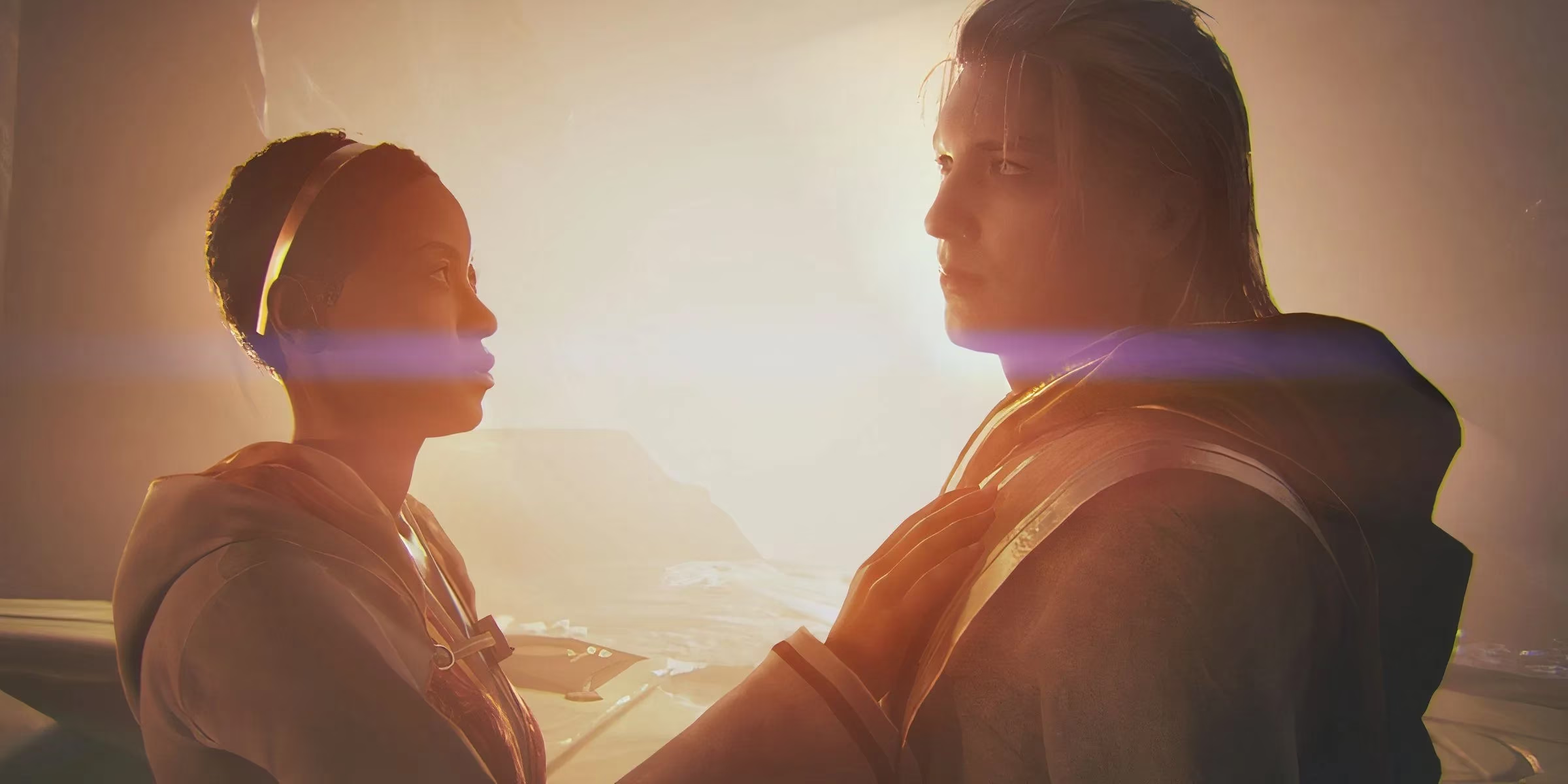
Merrin: The Linchpin of Cal's Humanity
At the heart of this precarious balance stands Merrin, the Nightsister of Dathomir. Her role has transcended that of an ally or even a lover; she has become Cal's tether to his own humanity, a grounding rod in the storm of his emotions. Their relationship mirrors the tragic history of Santari Khri and Dagan Gera—a warning from the past of what happens when a Jedi loses their anchor. More powerfully, it echoes the doomed romance of Padmé Amidala and Anakin Skywalker, illustrating how fear of loss can be the dark side's most potent poison.
Merrin's influence is both practical and profound:
-
A Moral Compass: She physically intervened to prevent Cal from using the dark side to execute ISB Chief Supervisor Denvik, demonstrating her power to "talk him down" from the brink.
-
An Equal in Power: Her mastery of Nightsister magic provides a counterbalance to his Force abilities, making her not just an emotional support but a partner who stands as his equal on the battlefield.
-
The Ultimate Stakes: Her near-death during the confrontation with Bode on Tanalorr was a narrative heart attack for players, explicitly showing that her survival is the fragile barrier between Cal and a full descent. Had she died then, in the immediate wake of Cere's and Eno's deaths, the fall would have been instant and catastrophic.
In essence, Merrin is to Cal what gravity is to a planet—an invisible, fundamental force that maintains orbit and prevents a chaotic spiral into the void.
The Tipping Point: A Future Without Merrin
The sequel's greatest narrative threat is not a SLord or an Imperial fleet, but the potential death of Merrin. Such an event would represent a salient and terrifying tipping point. Cal has managed to maintain a composed, if weary, demeanor despite the avalanche of loss. Merrin's death, however, could be the singular trauma that finally overloads his capacity to cope. The game has carefully stacked tragedies like kindling around his psyche:
-
Jaro Tapal & Prauf (Fallen Order) - The foundational loss.
-
Cere Junda & Eno Cordova (Survivor) - The destruction of his new family and hope.
-
Bode's Betrayal (Survivor) - The corruption of trust and friendship.
Merrin's death would be the spark. It would not be merely another loss; it would be the annihilation of his primary source of light, stability, and love. In the cold calculus of grief, it could appear as the galaxy's final verdict: that connection only leads to pain, and strength—true, unassailable strength—lies in the surrendering embrace of passion and power that the dark side offers. His journey would then complete a tragic inversion: from a Jedi hiding from the Empire to an avenger forged by it, his lightsaber casting not a blue or green glow, but the bloody crimson now synonymous with fallen knights.
Conclusion: Walking the Razor's Edge
As 2026 approaches, Cal Kestis stands on a razor's edge, his shadow stretching long behind him. The final Jedi game promises not just a conclusion to his trilogy, but a definitive answer to the question it has so masterfully posed: What is the breaking point of a good man? The narrative machinery is primed for a fall, with Merrin's life as the precarious counterweight. Her character is the keystone in the arch of his morality; remove it, and the entire structure collapses. Cal's potential turn is not framed as a simple choice between good and evil, but as a devastating, human reaction to unbearable suffering—a descent that would feel less like a corruption and more like a surrender. The galaxy awaits to see if the last spark of the Jedi Order will be extinguished, or if it can find a way to burn anew in the darkness, defiant and unbroken.
Leave a Comment
Comments